
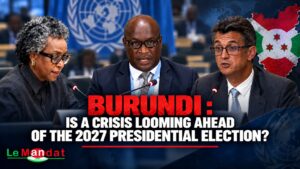
Less than eight months before Burundi’s presidential election, participants in the Human Rights Council debate in Geneva identified a range of threats that could weigh on the 2027 vote — but they do not agree on where those threats lie. UN Special Rapporteur Fortuné Gaetan Zongo, the European Union and several civil society organizations point mainly to political restrictions, impunity and the shrinking of civic space. The Burundian government, meanwhile, highlights Western pressure, the UN mechanism itself, as well as the RED-Tabara rebel movement and its alleged backers. (Le Mandat)
During the interactive dialogue on Burundi held on September 18, 2026, at the United Nations Human Rights Council, Fortuné Gaetan Zongo said that “the warning signs of an electoral crisis are already visible.”
According to the Special Rapporteur, the “window for prevention” remains open, but could close quickly. He grouped the factors that, in his view, could lead to a crisis around the May 2027 presidential election into four main warning signs.
The first warning sign is the restriction of political pluralism.
The May 2027 presidential election comes at the end of an electoral cycle marked by the dominance of the CNDD-FDD.
For Zongo, an election cannot be genuinely free if major competitors are excluded before the campaign even begins, or if the institutions responsible for overseeing and arbitrating the process do not enjoy the confidence of the relevant political actors.
He refers in this regard to Article 25 of the International Covenant on Civil and Political Rights, which protects, among other things, the right to take part in public affairs and to vote and be elected in genuine elections held by universal and equal suffrage and secret ballot.
The second warning sign concerns obstacles to genuine political competition.
The Electoral Code sets the deposit required for a presidential candidate at 100 million Burundian francs and imposes a two-year waiting period before someone who has left a political party can run as an independent.
Fortuné Gaetan Zongo considers these provisions disproportionate in light of Article 25 of the Covenant and argues that they could exclude potential candidates before the campaign even begins.
The third warning sign is the persistence of a coercive environment.
The Special Rapporteur refers to reports of summary or extrajudicial executions, enforced disappearances and other violations attributed in particular to members of the National Intelligence Service (SNR), the police and the Imbonerakure.
As long as such actors are able to exert pressure on the population in a climate of impunity, he argues in substance, the freedom of the vote remains seriously compromised.
The fourth warning sign is the recurrence of patterns seen during previous electoral cycles: political exclusions, intimidation, and pre- and post-election violence.
According to Zongo, these four factors are compounded by the continued shrinking of civic and media space, pressure on journalists, human rights defenders and opposition figures, widespread self-censorship and continuing concerns over the independence of the judiciary.
The Special Rapporteur says his role is to advise and anticipate a possible tipping point rather than react after the fact. He therefore recommends that the Human Rights Council establish specific follow-up on Burundi ahead of the 2027 election instead of waiting for the next annual reporting cycle.
His message echoes the title of his 2026 report: “Act before it is too late.”
Le Mandat had previously examined the main findings of Fortuné Gaetan Zongo’s report ahead of the 2027 presidential election and the prospects for a possible renewal of his mandate.
European Union and civil society share several of these concerns
The European Union presented a broadly similar assessment during the same dialogue.
It said it remained “deeply concerned” about the human rights situation in Burundi. While acknowledging some positive developments in recent years, the EU said violations remain widespread and political and civic space continues to shrink.
Ahead of the 2027 presidential election, the EU expressed particular concern over restrictions targeting opposition parties, the media, human rights defenders and civil society.
It stressed that an open and pluralistic political environment, together with respect for the freedoms of expression, association and peaceful assembly, is essential for free, inclusive and credible elections.
The European Union also referred to reports of summary or extrajudicial executions, arbitrary arrests and detentions, enforced disappearances, torture and sexual violence.
It called on the Burundian authorities to ensure independent, impartial and effective investigations, fight impunity and strengthen cooperation with United Nations mechanisms, including by allowing the Special Rapporteur access to the country.
At the same time, despite maintaining its criticism of Burundi’s human rights record, the European Union pointed out that it remains the country’s largest contributor to development aid.
Several human rights organizations taking part in the debate voiced similar concerns, focusing on restrictions on public freedoms, human rights violations, impunity and institutional weaknesses that could affect the electoral process.
For the government, the threat also comes from abroad
Burundi’s representative in Geneva, Elisa Nkerabirori, described the country-specific mandate on Burundi as a “hostile mechanism” and denounced what she called a “targeted campaign” and interference by certain Western powers.
According to the Burundian diplomat, keeping Burundi on the Human Rights Council’s agenda since the 2015 crisis has turned the mechanism into a diplomatic instrument aimed at isolating the country internationally, weakening it economically and exerting pressure on its institutions.
She singled out the European Union, Burundi’s main development partner and a driving force behind the mechanism at the Council, while accusing certain Western powers of using human rights concerns for political purposes.
Nkerabirori also argued that the UN mechanism is helping prepare international opinion to challenge the legitimacy of Burundi’s elections and is portraying the CNDD-FDD and its youth league, the Imbonerakure, in a negative light.
She then placed the confrontation in a historical context, invoking the resistance of the Kingdom of Burundi to German colonial forces at the end of the 19th century.
She recalled that Burundians, armed mainly with bows, arrows and spears, resisted for years against forces equipped with modern weapons, presenting the episode as an illustration of the country’s determination to defend its sovereignty.
“You push us to the wall, you mistreat us, and we do not bend,” she said, before portraying Burundi as standing “united under one shield.”
RED-Tabara: a threat raised beyond Gitega’s narrative
Elisa Nkerabirori also placed RED-Tabara — Resistance for the Rule of Law in Burundi — at the centre of her intervention.
She described the Burundian armed movement as a terrorist group, accused it of maintaining ties with the AFC/M23 coalition and repeated Gitega’s allegations that it receives logistical and military support from Rwanda.
She also alleged links between RED-Tabara leaders and certain European capitals.
Rwanda’s representative rejected the allegations against his country. Kigali, he said, remains committed to dialogue and cooperation in support of peace, security and stability in the region and would respond to what he described as “unfounded allegations.”
The International Federation for Human Rights (FIDH), together with its member and partner organizations, also introduced the regional security dimension into its assessment of risks surrounding the election. They argued that the armed conflict in neighbouring Democratic Republic of the Congo and the activities of armed groups, including RED-Tabara, constitute an additional risk to the holding of a peaceful election in Burundi.
In the section of his report dealing with the fragility of the security and health situation, Special Rapporteur Fortuné Gaetan Zongo also notes that areas along the border with the Democratic Republic of the Congo are affected by the movement of weapons and fighters, including those belonging to M23 and RED-Tabara.
