
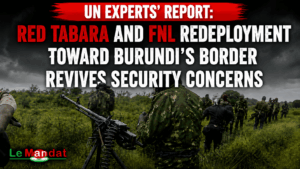
A new report by the United Nations Group of Experts on the Democratic Republic of the Congo (DRC) says RED-Tabara and Forces Nationales de Libération (FNL) fighters redeployed to the hills overlooking Sange, near Burundi’s western border. According to the report, the move, combined with their cooperation with AFC/M23, Twirwaneho and the Rwanda Defence Force (RDF), has heightened security concerns among Burundian authorities. (Le Mandat)
The report describes the gradual alignment of the two Burundian rebel movements, Résistance pour un État de droit au Burundi (RED-Tabara) and the Forces Nationales de Libération (FNL), with a coalition composed of the Alliance Fleuve Congo/March 23 Movement (AFC/M23), the Twirwaneho armed group and the Rwanda Defence Force (RDF), as the AFC/M23 crisis expanded into South Kivu.
The document says RED Tabara and the FNL have been targeted by joint military operations conducted by the Burundi National Defence Force (FDNB) and the Armed Forces of the Democratic Republic of the Congo (FARDC) since 2023.
A strategic redeployment after Uvira
According to the report, AFC/M23 and the RDF carried out a series of strategic redeployments after withdrawing from Uvira.
The experts say that, despite calls made by the United States at the UN Security Council for a withdraw at least 75 kilometres north of Uvira, AFC/M23 and RDF only pulled back as far as Sange, about 35 kilometres north of the border city, where AFC/M23 established its South Kivu headquarters.
The experts describe the move not as a genuine withdrawal, but as a tactical repositioning aimed at maintaining control of strategic areas around Uvira and across the Moyens and Hauts Plateaux, while preserving the coalition’s ability to conduct further military operations.
The report adds that one contingent was deployed to the Hauts Plateaux to reinforce Twirwaneho and RED-Tabara fighters, while other units repositioned around Uvira, Sange and Makobola.
Joint military operations
According to the experts, the two Burundian rebel movements took part in several joint military operations alongside AFC/M23, Twirwaneho and the RDF during the reporting period.
They say the coalition captured several strategic positions along the Mwenga–Fizi axis, including Point Zéro, Kanguli and Tuwe Tuwe, while continuing operations in and around Minembwe in January and February 2026.
The report also notes that RED-Tabara had long-standing camps in Masango, in Uvira territory, as well as Magunda and Kipupu, both in Mwenga territory.
Although RED-Tabara leaders have repeatedly denied any links with AFC/M23, the experts say RED-Tabara fighters took part in hostilities alongside AFC/M23, Twirwaneho and the RDF on several fronts, including Muranvia, Bijabo, and routes leading to Minembwe.
The report adds that FNL fighters were present in the Nyaburunda forest, in Uvira territory, as well as in mountainous areas near Sange. In Magunda, they shared positions with RED-Tabara units.
RED-Tabara and FNL move closer to Burundi’s border
By mid-February 2026, RED Tabara and FNL fighters had physically joined the AFC/M23-RDF-Twirwaneho coalition in the Kamombo sector of the Hauts Plateaux, according to the experts.
The report adds that other fighters from the two rebel movements redeployed from the Hauts Plateaux of Fizi, Uvira and Mwenga toward the hills overlooking Sange, close to Burundi’s border.
According to the experts, the proximity of these fighters to the border, combined with their participation in military operations alongside AFC/M23 and the RDF, has heightened concerns among Burundian authorities, who fear the groups could be used to destabilize Burundi.
Border reopening under tight security
The report places Burundi’s border measures in the context of the evolving military situation around Uvira.
After AFC/M23 captured the border city in December 2025, Burundi closed several border crossings with the DRC and designated parts of the frontier as military zones, citing the deteriorating security situation.
Several weeks later, after AFC/M23 withdrew from Uvira, Burundi reopened a number of border posts on 25 February 2026, citing economic, humanitarian and operational considerations.
The experts stress, however, that the decision did not reflect a reduction in security concerns.
Instead, they say it marked a shift from emergency border closures to a reinforced border security system, characterized by increased military deployments, intensified patrols at key crossing points and tighter controls on cross-border movement.
Recruitment and training allegations in Rwanda
The report also says RED-Tabara has long maintained ties with Rwanda and the Rwanda Defence Force.
According to the experts, recruitment for the Burundian rebel movement continued in refugee camps in Rwanda, particularly Mahama camp. According to them, recruits were then transferred to the military facilities at Gako, Gashora and Gabiro, where they received military training.
Read also Burundi: Beaten by Imbonerakure, Seif Ntakamurenga dies from his injuries
