
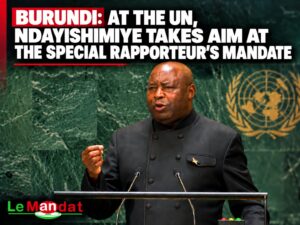
Burundian President Évariste Ndayishimiye used his address to the 81st session of the United Nations General Assembly to denounce what he sees as the politicization of the Human Rights Council against certain states. Speaking also in his capacity as the current Chair of the African Union, he reiterated Burundi’s opposition to the Special Rapporteur tasked with monitoring the human rights situation in the country. At the same time in Geneva, a draft resolution seeking to renew that mandate is being finalized. (Le Mandat)
Évariste Ndayishimiye framed Burundi’s rejection of the UN mechanism within a broader call for a stronger African voice in international institutions.
“Africa must be listened to more, better represented and more closely involved in decisions that determine the future of our planet,” the Burundian president said.
For Ndayishimiye, who currently chairs the African Union, greater representation of the continent should help strengthen trust between Africa, other regions of the world and international institutions.
Human Rights Council in the crosshairs
“We no longer want to see the Human Rights Council become a forum for oppressing countries deliberately singled out because they defend and fight for the interests of their people,” Évariste Ndayishimiye said.
He called for the uniform application of international human rights law, arguing that all states should be held to the same standards and that the Council should not be “instrumentalized by certain countries to the detriment of other states,” given the principle of sovereign equality among UN member states.
It was in the continuation of that argument that the Burundian president turned directly to the mechanism dealing with his own country.
“Burundi wishes to reiterate consistently its opposition to the imposition of a Special Rapporteur on the human rights situation in Burundi,” he said, arguing that the mechanism had been established “without any prior dialogue or consultation.”
Ndayishimiye instead described Burundi as “a responsible country that respects human rights,” saying it fights impunity and works to prevent the recurrence of crimes committed in the past.
A few days earlier, during the September 18 interactive dialogue on Burundi in Geneva, the European Union had defended the opposite position, calling on Gitega to cooperate with the Special Rapporteur and allow him access to the country.
From Commission of Inquiry to Special Rapporteur
The current mechanism traces its origins to Burundi’s 2015 crisis.
In 2016, the Human Rights Council established a Commission of Inquiry on Burundi tasked, among other things, with investigating human rights violations committed since April 2015 and contributing to efforts to combat impunity.
However, the Commission was never granted access to Burundian territory. The authorities refused to cooperate with it and challenged its legitimacy.
After the Commission’s mandate ended, the Human Rights Council created the mandate of Special Rapporteur on the human rights situation in Burundi in 2021. Fortuné Gaetan Zongo took up the position in 2022.
The lack of access to the country continued under the new mechanism: Zongo has likewise never been authorized to conduct an official visit to Burundi, despite the Council’s explicit calls for the authorities to grant him unhindered access.
Le Mandat has previously published an analysis of the prospects for renewing the Special Rapporteur’s mandate as well as a detailed article on his latest report and the risks identified ahead of the 2027 presidential election.
In Geneva, renewal of the mandate is already on the table
Ndayishimiye’s speech comes precisely as the future of the mechanism is being decided in Geneva.
During the 63rd session of the Human Rights Council, the European Union announced its intention to table a resolution on the human rights situation in Burundi that includes renewal of the Special Rapporteur’s mandate.
The process has already moved into a concrete phase: a draft resolution is being finalized and negotiated ahead of its consideration by the Council, scheduled for early October.
