
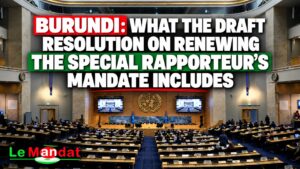
The United Nations Human Rights Council is expected to decide in the coming days on a draft resolution that would extend for another year the mandate of the Special Rapporteur on the situation of human rights in Burundi. The text largely builds on the resolution adopted in October 2025, while introducing several refinements: heightened concern over extrajudicial killings and enforced disappearances, more detailed requirements ahead of the 2027 presidential election, and additional demands concerning the media, civil society, investigations into human rights violations and efforts to combat hate speech. (Le Mandat)
The draft provides for the mandate of the Special Rapporteur on the situation of human rights in Burundi to be extended for a further year. It also requests the mandate holder to submit a comprehensive report to both the Human Rights Council and the United Nations General Assembly.
In October 2025, the same mechanism was renewed by 23 votes to 9, with 15 abstentions. Burundi voted against the resolution.
A comparison of the two texts shows substantial continuity, although some concerns are developed in greater detail, several requirements are more specific and a number of new elements appear this year.
Le Mandat has previously published an analysis of the issues surrounding the renewal of the Special Rapporteur’s mandate as well as a detailed article on Fortuné Gaetan Zongo’s latest report and the risks identified ahead of the 2027 presidential election.
2027 presidential election: more detailed safeguards
The 2027 presidential election was already addressed in last year’s resolution. The Council had called on the Burundian government to create the conditions necessary for an “inclusive, transparent and credible” presidential election.
The 2026 draft retains that demand but sets out more specific requirements. It calls on the government to ensure that political actors, journalists, election observers, human rights defenders, civil society actors and citizens can participate freely throughout the electoral process, including through election monitoring and observation.
The text also notes that the 2025 parliamentary and local elections were “mostly without violent incidents”, while expressing concern over reports that the conditions necessary for inclusive, transparent, competitive and credible elections were not met.
It points in particular to the further closure of civic and media space, the lack of political pluralism and conditions for fair electoral competition, growing intimidation of critical voices and a climate of fear surrounding the electoral process.
Extrajudicial killings and disappearances: an “alarming increase”
As in 2025, the draft strongly condemns extrajudicial killings, enforced disappearances, arbitrary arrest and detention, acts of torture and other cruel, inhuman or degrading treatment or punishment, as well as sexual and gender-based violence.
But the 2026 text introduces stronger language. It notes an “alarming increase in extrajudicial killings and enforced disappearances”, describing it as the continuation of an alarming trend in place since the Commission of Inquiry on Burundi was established in 2016.
The draft also strengthens the section dealing with impunity. It calls on the government to conduct prompt, independent and transparent investigations into all human rights violations and abuses and to hold all perpetrators accountable regardless of their affiliation or status.
Members of the defence and security forces and the Imbonerakure — described in the official text as the ruling party’s youth league — are explicitly mentioned.
The previous resolution already called for perpetrators to be held accountable and for victims to have access to justice and legal redress. The current draft, however, more explicitly requires independent and transparent investigations.
The call for Burundi to reconsider its withdrawal from the Rome Statute and to cooperate fully with the International Criminal Court regarding its ongoing investigation is also maintained.
Media and civil society: the text goes further
Restrictions on civic space were already among the Council’s concerns in 2025. The Council had called for journalists, activists, bloggers and human rights defenders to be able to carry out their work without intimidation or undue interference.
The 2026 draft more explicitly condemns harassment, intimidation and reprisals, as well as arbitrary arrest, prolonged detention and judicial prosecution targeting lawyers, human rights defenders, journalists and civil society actors.
It also calls on the government to amend restrictive laws governing non-governmental organizations and the media.
In addition, it demands the immediate and unconditional release of people who remain detained for carrying out human rights work or for exercising their human rights.
The draft also maintains demands concerning the full independence of the judiciary and that of the National Independent Human Rights Commission, which the government is called upon to provide with all the means necessary to carry out its functions in accordance with the Paris Principles.
UN Human Rights Office: a reopening timeline still awaited
The resolution adopted in 2025 had already called on the Burundian government to present a timeline for reopening the country office of the Office of the United Nations High Commissioner for Human Rights.
One year later, the new draft explicitly regrets the “lack of progress in reopening its country office”.
The draft again encourages the government to “present a timeline for the reopening” of the office. It also specifies that the office should have a mandate to protect, promote and monitor human rights, with unhindered access, while providing technical assistance and capacity-building.
Access to the country also remains an issue for the Special Rapporteur. As in 2025, the government is urged to cooperate fully with Fortuné Gaetan Zongo, provide him with all the information necessary for the proper fulfilment of his mandate and permit him unhindered access to the country.
Torture and hate speech: new elements
The draft also calls on Burundi to cooperate fully with the United Nations Subcommittee on Prevention of Torture regarding its planned country visit. The text notes that the visit was announced in July 2026.
The section on discrimination has also evolved. The draft calls on the government to take meaningful, concrete steps to combat discrimination in all its forms and explicitly adds the need to address the spread of hate speech and incitement to violence, including through comprehensive anti-discrimination policies and accountability.
Progress also acknowledged
As in 2025, the draft notes with appreciation the efforts made regarding Burundi’s regional and international participation, the fight against trafficking in persons and the repatriation of Burundian refugees.
The 2026 text also stresses the importance of guaranteeing the security, social integration and rights of returnees.
It further takes note of commitments made towards improving human rights, good governance and the rule of law, as well as the release of some political prisoners.
Next week, during the final days of the Human Rights Council’s 63rd session, which ends on October 7, Council members are expected to consider the draft resolution on Burundi. If the text is put to a vote, its adoption will depend on a simple majority of members present and voting; abstentions are not counted among the votes cast.
Watch below the full recent interactive dialogue on the human rights situation in Burundi at the United Nations Human Rights Council.
