
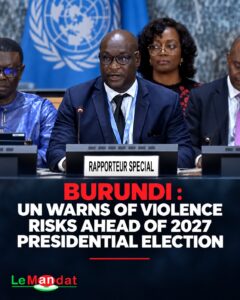
United Nations Special Rapporteur on the human rights situation in Burundi, Fortuné Gaetan Zongo, paints a troubling picture of the country less than a year before the 2027 presidential election. Summary or extrajudicial executions, enforced disappearances, torture, arbitrary arrests, shrinking political space, poverty and pressure on refugees are among the main concerns highlighted in his latest report. (Le Mandat)
Fortuné Gaetan Zongo says he remains “deeply concerned” by reports of summary or extrajudicial executions, enforced disappearances, torture and ill-treatment. His report will be at the heart of the interactive dialogue on Burundi scheduled for September 18, 2026, at the UN Human Rights Council, where Zongo is expected to present his findings and recommendations.
The report cites data from the Burundian Human Rights League ITEKA, which documented at least 402 deaths in 2025, including more than 110 summary or extrajudicial executions attributed to the Imbonerakure, the youth league of the ruling CNDD-FDD.
During the first six months of 2026, ITEKA documented 182 deaths. The organization also reported 55 enforced disappearances in 2025 and another 25 during the first half of 2026.
The Special Rapporteur also draws attention to the security situation along Burundi’s border with the Democratic Republic of the Congo (DRC). He notes that the area is affected by the movement of weapons and fighters, including members of the Mouvement du 23 mars (M23) and the Résistance pour un Etat de Droit au Burundi (RED-Tabara).
The security concerns are compounded by a public health threat. The report warns that the Ebola outbreak in the DRC poses a risk to Burundi, which it describes as structurally vulnerable to epidemics because of weaknesses in its health infrastructure and other public services.
Unidentified bodies: independent exhumation and evidence-preservation mechanism urged
The Special Rapporteur notes that unidentified bodies continue to be found, often bound, mutilated or dumped in rivers. There are also reports of clandestine burials in mass graves.
The information reviewed by the Special Rapporteur mainly implicates officers of the National Intelligence Service, police officers and members of the Imbonerakure.
Fortuné Gaetan Zongo recommends establishing an independent mechanism for the exhumation and identification of remains and the preservation of evidence, particularly with a view to future truth and justice processes.
Torture: unofficial detention facilities under scrutiny
The Special Rapporteur reports that torture is allegedly used as a tool of political repression and extortion, particularly during interrogations conducted by National Intelligence Service officers in unofficial detention facilities.
He also expresses concern over what he describes as persistent denial of such practices by the authorities. Fear of reprisals, he says, discourages some victims, health professionals and lawyers from identifying certain injuries as resulting from torture.
Arbitrary detention: UN calls for centralized register
The Association for the Protection of Human Rights and Detained Persons in Burundi (APRODH) documented 245 arbitrary arrests followed by unlawful detention between July and December 2025, mainly involving alleged opposition members, journalists and human rights defenders.
Action by Christians for the Abolition of Torture in Burundi (ACAT-Burundi) and the International Federation of ACATs (FIACAT) have also reported inhuman treatment, unlawful transfers allegedly ordered by the National Intelligence Service and unjustified re-incarceration in the prisons of Mpimba, Gitega, Ngozi, Rumonge, Ruyigi and Muramvya.
ITEKA, for its part, documented 217 victims of arbitrary arrest and detention in 2025, with another 15 cases recorded during the first half of 2026.
In response to incommunicado detention and allegations concerning unofficial detention sites, Fortuné Gaetan Zongo recommends the establishment of a centralized, up-to-date and accessible register of all persons deprived of their liberty. It should record, among other information, the place and legal basis of detention, the authority responsible and the detainee’s state of health.
He also calls for the immediate closure of all unofficial detention facilities.
The Special Rapporteur further describes a judicial system facing serious problems of independence and impartiality. He says that people who have been acquitted remain in detention, that some pre-trial detentions are arbitrarily prolonged and that judges and magistrates face pressure.
Burundi’s prisons, designed to hold around 4,000 inmates, are accommodating several times that number. The Special Rapporteur says Burundi has failed to meet its commitment under the “Human Rights 75” initiative to ease prison overcrowding by December 1, 2025.
He therefore calls for the immediate release of people who have been acquitted, those who have completed their sentences, those held beyond legal time limits and those imprisoned for minor non-violent offences. He also recommends alternatives to pre-trial detention.
CNIDH and CVR under pressure
The Special Rapporteur says the Independent National Human Rights Commission (CNIDH) and the Truth and Reconciliatiation Commission (CVR) continue to face “serious political interference and pressure,” undermining their independence, impartiality, transparency and credibility.
Fortuné Gaetan Zongo recommends reforming the procedures used to appoint members of both institutions.
In the case of the CNIDH, he also asks the Global Alliance of National Human Rights Institutions to conduct a special review of its status to determine whether it complies with the Paris Principles.
Regarding the Truth and Reconciliation Commission, he calls for its mandate, composition and functioning to be brought into line with the spirit of the Arusha Peace and Reconciliation Agreement.
2027 presidential election: revise Electoral Code and strengthen CENI independence
For Fortuné Gaetan Zongo, the 2025 legislative elections, after which the CNDD-FDD secured every seat in the National Assembly, already represent a warning sign.
He also points to Agathon Rwasa’s removal from the leadership of the CNL and his exclusion from political competition, as well as obstacles introduced by the 2024 Electoral Code.
The deposit required to stand in the May 3, 2027 presidential election has been raised to 100 million Burundian francs, while people who leave a political party face a two-year waiting period before they can run as independents.
The Special Rapporteur therefore recommends revising restrictive provisions in the Electoral Code, safeguarding the independence of the National Independent Electoral Commission (CENI), protecting opposition parties and guaranteeing equitable media access and freedom of peaceful assembly.
On May 8, 2026, five political parties announced that they were withdrawing from CENI meetings, a move that Zongo says reflects particularly troubling mistrust of the impartiality of the electoral process.
The report also cites an analysis by the Kofi Annan Foundation that places Burundi under its highest level of monitoring and estimates the probability of violence linked to the 2025-2027 electoral cycle at more than 98%.
Restrictions extend to the media. Despite Burundi moving up six places in Reporters Without Borders’ 2026 World Press Freedom Index, the Special Rapporteur points to surveillance, widespread self-censorship and restrictions on reporting on certain issues.
He therefore recommends reopening civic and media space before the 2027 pre-election period and urges the international community to support independent election observation and post-election monitoring.
Special Rapporteur calls for demobilization of Imbonerakure involved in security operations
Fortuné Gaetan Zongo calls on the authorities to “demilitarize and demobilize” Imbonerakure members involved in security or repressive activities. The Special Rapporteur says their growing role means that, in some of their activities, they have become comparable to a paramilitary organization.
He recommends barring them from surveillance, intimidation and population-control activities and prosecuting members involved in human rights violations.
The report also refers to the recruitment or mobilization of children in schools and during CNDD-FDD gatherings. Some children were allegedly used for surveillance, intelligence-gathering, intimidation and, in some cases, physical violence.
The Special Rapporteur therefore calls on the government to identify, demobilize and reintegrate any child associated with political or security structures, including the Imbonerakure, and to keep schools free from such activities.
Regarding women and girls, the report cites more than 200 serious human rights violations documented between December 2024 and October 2025 by the Movement of Women and Girls for Peace and Security in Burundi (MFFPS) and the World Organisation Against Torture. More than 70% involved gender-based violence against women and girls.
Fortuné Gaetan Zongo recommends confidential reporting mechanisms, access to medical and psychosocial care, legal assistance and effective investigations.
Poverty, food insecurity and health: protect priority social spending
The report estimates that 75.1% of Burundi’s population experiences multidimensional poverty, representing roughly 9.4 million people living below the $3-a-day threshold. Around 1.8 million people were experiencing crisis-level food insecurity between October and December 2025, while 56% of children under five suffer from stunting.
The Special Rapporteur also highlights weak health infrastructure and shortages of qualified personnel, against a backdrop of an influx of Congolese refugees and a resurgence of cholera.
He recommends that the government protect priority spending on health, education, water, sanitation and food security, with particular attention to vulnerable groups.
Fortuné Gaetan Zongo also acknowledges the importance of the “Burundi, emerging country by 2040 and developed country by 2060” vision, but criticizes some of the methods used to implement it. He cites, in particular, requirements imposed on some residents to pay for paving works outside their properties, backed by fines amounting to several hundred thousand Burundian francs and, in Buhumuza province, threats of imprisonment.
The Special Rapporteur recommends suspending disproportionate sanctions and introducing exemptions for vulnerable households.
Repatriations from Tanzania: suspend numerical targets without adequate safeguards
More than 28,000 Burundian refugees were repatriated from Tanzania during the first two months of 2026, bringing the total number of returns since the initial 2017 agreement to more than 180,000.
In early May 2026, Tanzanian authorities permanently closed Nduta refugee camp amid an accelerated repatriation drive.
Although UNHCR formally describes the returns as voluntary, the Special Rapporteur reports allegations of pressure, shelter demolitions, restrictions on movement, closures of essential services, torture, arbitrary arrests and enforced disappearances.
He draws particular attention to about 17,000 Burundian refugees who say they cannot return because of security risks or fears of political persecution. They include opposition party members, former military personnel and human rights defenders.
According to Fortuné Gaetan Zongo, the current situation in Burundi does not allow the conclusion that conditions for a voluntary, safe and dignified return are in place for these individuals.
The Special Rapporteur recommends an individual assessment to verify each refugee’s free and informed consent before repatriation, as well as the suspension of numerical return targets where they risk placing indirect pressure on refugees.
He also calls for the establishment of an independent mechanism to monitor returnees for at least 12 months after their return, in order to detect possible reprisals, arbitrary arrests, disappearances or deprivation of property.
He further urges donors to respond to UNHCR’s appeal for an additional $82 million to ensure adequate assistance for refugees and returnees and prevent humanitarian funding shortages from becoming a de facto driver of coerced returns.
High-level international dialogue urged before 2027
Against what he describes as structural impunity, Fortuné Gaetan Zongo calls on the international community, the African Union, the East African Community, the European Union and bilateral partners to step up their efforts.
He recommends, among other measures, continued follow-up on the International Criminal Court proceedings, support for mechanisms to document and preserve evidence, and sustained financial and political backing for Burundian civil society.
Finally, he calls on the Human Rights Council to urge Burundi to cooperate fully with international human rights mechanisms, authorize the reopening of the Office of the UN High Commissioner for Human Rights in the country and convene, before 2027, a high-level dialogue on the human rights situation in Burundi involving civil society.
