
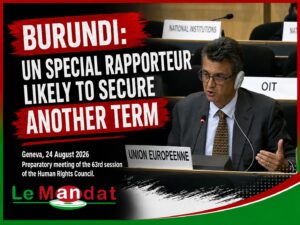
The European Union has already announced that it will table a draft resolution at the 63rd session of the UN Human Rights Council seeking to renew the mandate of the Special Rapporteur on the situation of human rights in Burundi. The main uncertainty now lies with the vote. But given previous voting patterns, continuing international concerns and, above all, the approach of the 2027 presidential election, another extension currently appears to be the most likely outcome. (Le Mandat)
The announcement was made on 24 August 2026 at the Palais des Nations in Geneva, during the organizational meeting for the 63rd regular session of the UN Human Rights Council, which is scheduled to run from 7 September to 9 October 2026.
Speaking about Burundi, the EU representative announced that the bloc would table a draft resolution seeking to renew the mandate of the Special Rapporteur on the situation of human rights in Burundi, currently held by Fortuné Gaetan Zongo.
To justify the initiative, the EU representative pointed both to the human rights situation and to the approaching electoral deadline. “The situation in the country continues to be marked by a volatile security context and continued impunity for human rights violations,” he said, adding that continued scrutiny was particularly relevant as Burundi heads towards elections in 2027 and the current electoral cycle continues.
The position of the European Union, which acts as penholder on the situation of human rights in Burundi, is therefore clear: the question is no longer whether the mandate will be extended, but whether the Council will approve that extension.
This position comes as no surprise. On 29 June 2026, during the interactive dialogue with Fortuné Gaetan Zongo at the Council’s 62nd session, the EU once again expressed its support for his mandate while maintaining that the human rights situation in Burundi remained a matter of concern.
The approaching 2027 presidential election now weighs heavily in the equation. By explicitly linking the continuation of the mandate to the current electoral cycle, the European Union has made clear that it considers continued independent scrutiny particularly important as Burundi moves towards the presidential poll.
Ending country-specific monitoring only months before that election would also mark a significant departure from the approach followed by the Council since the 2015 crisis. When the mandate of the Commission of Inquiry on Burundi came to an end in 2021, the Council did not end its scrutiny of the country. Instead, it established the mandate of the Special Rapporteur. The mechanism changed, but international monitoring continued.
The Burundian government, however, continues to reject the mechanism and has still not granted the Special Rapporteur access to the country. So far, that opposition has not prevented successive extensions.
A voting balance that has so far favoured another term
In October 2025, the Human Rights Council extended the mandate by 23 votes in favour, 9 against and 15 abstentions.
The main uncertainty therefore lies in whether the balance of votes among the Council’s 47 members has shifted.
For a further extension to fail this year, the positions of a significant number of Council members would have to change compared with the previous vote. So far, however, there has been no major public indication of such a shift.
The approach of the 2027 presidential election further strengthens the case made by States supporting the continuation of an independent mechanism to monitor the human rights situation in Burundi.
The bid for another term is therefore no longer in doubt: the European Union has officially announced that it will bring the matter before the Council. What remains uncertain is the outcome of the vote. But unless there is a significant shift in the balance of forces, all current indications suggest that Fortuné Gaetan Zongo is likely to secure another year in office.
